
SaaS Growth: Key Benefits of AI Landing Page Generators
Discover how modern SaaS companies and growth marketers scale campaigns, increase conversion rates, and optimize visual web design automatically using generative AI tools.
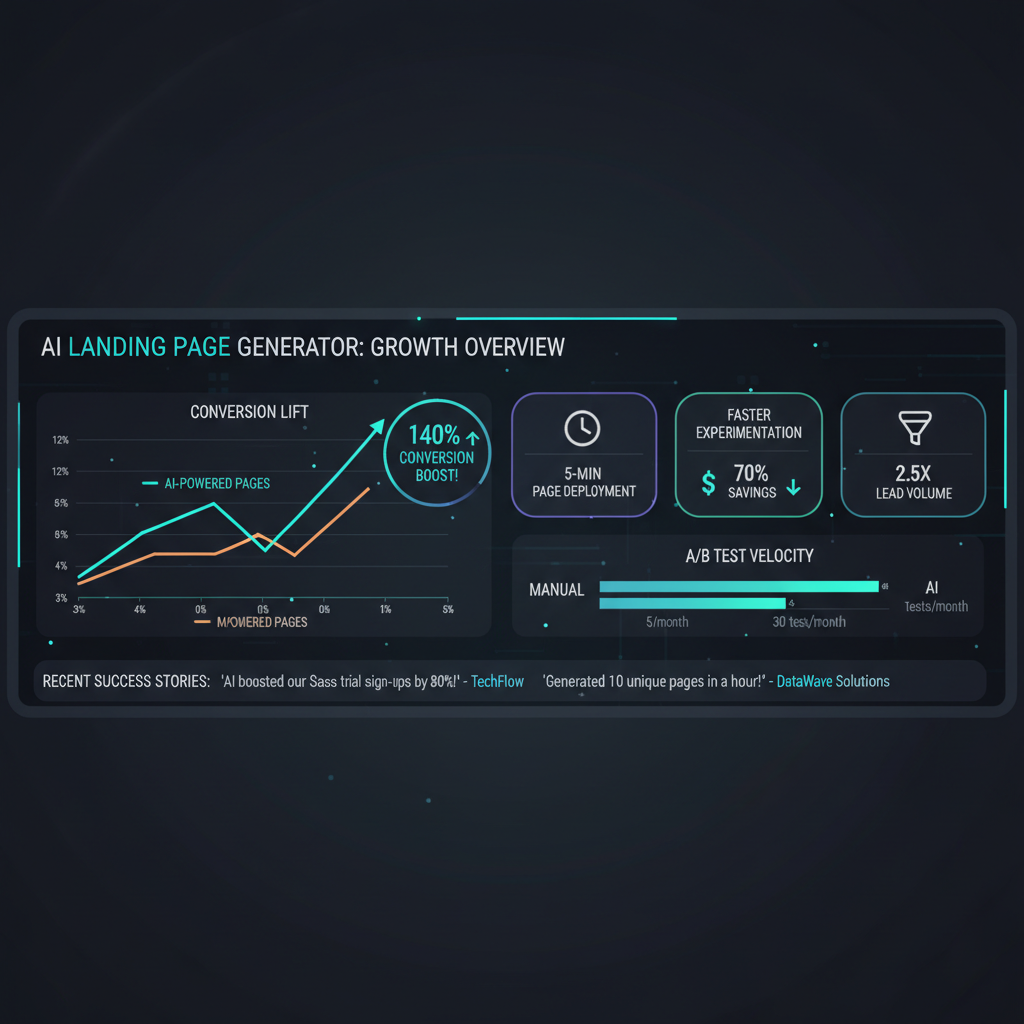
The New Era of High-Speed Customer Acquisition
In modern software and e-commerce marketing, speed of execution is the ultimate competitive advantage. Companies that can quickly test dedicated landing pages for specific ad groups, buyer personas, and traffic channels generate significantly more qualified leads than those relying on a single static homepage.
AI landing page generators remove the technical and financial bottlenecks of traditional web design. By combining intelligent layout synthesis, conversion-focused copywriting, and clean code generation, AI empowers growth teams to scale marketing campaigns efficiently.
5 Core Business Benefits of AI Landing Page Generators
1. 10x Faster Campaign Launch Speeds
Traditional landing page development requires copywriters, UI designers, and frontend engineers collaborating for weeks. AI landing page generators translate product descriptions into live, responsive web pages in minutes, allowing marketing teams to test new ad campaigns on the same day.
2. Higher Conversion Rates & Ad Quality Scores
AI generators structure landing pages around proven visual hierarchy patterns—placing hero value propositions, social proof trust badges, and primary action buttons where users naturally look. This boosts conversion rates and lowers Cost Per Lead (CPL) on Google and Meta ad campaigns.
3. 90% Reduction in Upfront Development Costs
Hiring a digital agency or freelance developer for custom landing page design typically costs between $2,000 and $10,000 per page. AI platforms deliver production-ready HTML, CSS, and React code for a fraction of the cost, freeing up capital for user acquisition.
4. Rapid Multi-Variant A/B Testing
Instead of testing minor headline changes on a single static page, AI generators allow growth marketers to create completely unique visual variants tailored to distinct audience segments, industries, or traffic channels.
5. Mobile-First & Core Web Vitals Optimization
Over 60% of landing page visitors come from mobile devices. AI generators output clean, inline CSS and responsive grid architectures that load in under 1.5 seconds, ensuring high Google PageSpeed scores.
The case for generating landing pages is not that a generator designs better than a person. It is that the cost of producing a page falls far enough to make a practice possible that everybody already knows works and almost nobody does: a separate page for each campaign.
Message match is the whole argument
A visitor who clicks an ad about a specific problem and lands on a general page has to work out for themselves whether they are in the right place. A meaningful share do not bother.
The fix is well understood: the page should echo the ad. Same problem named, same language, same promise. This is not a subtle optimisation — it is the difference between a page that feels like the answer to your search and one that feels like a company's homepage.
Message match implies a page per campaign, sometimes per ad group. That has always been the recommendation and it has rarely been the practice, for a simple reason.
Why nobody did it before
A landing page used to cost a designer's week and a developer's week. At that price you build one page, run all your traffic to it, and the recommendation to build twelve remains theoretical.
So teams compromised: one page, broad enough to accept traffic from every campaign, which by construction matched none of them precisely.
When a page costs an hour, the arithmetic changes and the practice becomes available. That is the actual benefit — not better pages, but the right number of them.
Testing stops requiring a business case
The second-order effect is on experimentation.
When producing a variant is expensive, testing needs justification: enough traffic for significance, a hypothesis worth the effort, someone's time allocated. Most tests never get run because the overhead exceeds the expected value.
When a variant costs minutes, you can test things that would never have survived a prioritisation meeting — a different opening section, a different objection handled first, a shorter page. Some of those are the ones that would have moved the number, and they were previously unaffordable.
Campaigns become disposable, which is correct
A page for a seasonal promotion, an event, a partnership, a single webinar — these have a natural lifespan of weeks.
Building them at traditional cost means either not building them or building something permanent for a temporary purpose, which is how sites accumulate campaign pages from three years ago that nobody can delete because nobody is sure.
Cheap production makes disposability practical. Build it for the campaign, run it, archive it. That is a healthier pattern than a growing collection of half-relevant pages, and it only works when producing one is not an investment.
Where it does not help
Worth being clear, because the benefit is narrower than the marketing suggests.
A generator does not know what your offer should be, what objection is stopping people, or which segment is worth targeting. It produces pages; the strategy behind which pages to produce is entirely yours.
And more pages is not itself a benefit. Twelve campaign pages that all say the same thing are worse than one page, because you have split your effort and your data without gaining message match. The benefit only materialises if each page genuinely matches a distinct campaign.
What good practice looks like
Build one strong page and treat it as the pattern. For each campaign, duplicate it and change the opening — headline, subheadline, and the first proof point — to match the ad. Keep the rest.
That gives you message match where it matters, at the top of the page where the decision to stay is made, without maintaining twelve entirely separate pages.
And retire them. A campaign page whose campaign ended should come down or redirect, not linger as a page that ranks for nothing and dilutes your site.
The benefit is a page per campaign, which everyone knew worked and almost nobody could afford. Change the opening to match each ad, keep the rest, and retire pages when the campaign ends.
Frequently Asked Questions
Why are SaaS companies switching to AI landing page generators?
SaaS companies rely on rapid iteration. AI landing page generators enable marketing teams to launch dedicated landing pages for specific feature releases, customer verticals, and PPC campaigns without waiting for developer sprint cycles.
Can I export clean code from AI landing page generators?
Yes. Leading AI generators like Redesignr.ai output standalone HTML, CSS, and React code that you can host on Vercel, Netlify, or your own servers with zero vendor lock-in.
How does AI landing page generation impact conversion rates?
By matching visual styling and messaging directly to specific user intent and ensuring sub-2-second page load times, AI-generated landing pages typically achieve conversion rates between 8% and 15%.
Scale Your Landing Page Campaigns Today
Experience the power of AI-driven landing page generation with Redesignr.ai. Create responsive, high-converting layouts in minutes.
Start AI Landing Page Generator